
Headaches that develop after reading, studying, screen use, or other close-up tasks are extremely common — but they are not something you should ignore or simply “push through.”
While many people assume this is normal eye strain, these symptoms often point to an underlying issue with how your eyes focus, coordinate, or sustain near work.
For many patients across Berry, Nowra and the Shoalhaven, identifying and addressing the cause can significantly improve comfort and reading endurance.
Why Do I Get Headaches After Reading?
When you perform close work, your eyes must constantly adjust to maintain clear, single vision. This involves:
Focusing (accommodation)
Eye coordination (binocular vision)
Sustained visual attention
Light and contrast adaptation
If any part of this system is inefficient, your visual system works harder than it should — leading to fatigue and headaches.
Common Causes of Reading-Related Headaches
1. Eye strain and focusing fatigue
The eye’s focusing system can become overworked during prolonged near tasks.
Symptoms include:
Headaches after 10–30 minutes of reading
Blurry vision developing over time
Needing frequent refocusing
2. Binocular vision dysfunction
Your eyes must work together precisely. If coordination is slightly off, your brain compensates.
This may cause:
Forehead or temple headaches
Eye fatigue
Losing place while reading
Words appearing unstable
3. Convergence insufficiency
A specific condition where the eyes struggle to maintain alignment for near work.
Symptoms include:
Reading-related headaches
Difficulty sustaining focus
Eye strain or pulling sensation
Avoidance of reading tasks
4. Uncorrected prescription
Even small vision changes can significantly impact reading comfort.
Common in:
Mild long-sightedness
Astigmatism
Undiagnosed near vision strain
5. Dry eye
Dryness leads to fluctuating vision, forcing constant refocusing.
Common triggers:
Screen use
Reduced blinking
Air conditioning
Long reading sessions
The 20/20/20 Rule (Eye Strain Prevention)
The 20/20/20 rule helps reduce visual fatigue during prolonged near work.
Every 20 minutes, look at:
Something 20 feet (6 metres) away
For 20 seconds
Why it helps
Near work keeps the focusing system active for long periods. Regular distance breaks allow the eye muscles to relax.
Helps with:
Eye fatigue
Mild headaches
Blurry vision from overuse
Reduced concentration
Important note
This rule helps with symptoms, but does not treat underlying causes such as:
Binocular vision problems
Prescription issues
The Harmon Reading Distance (Comfortable Working Distance)
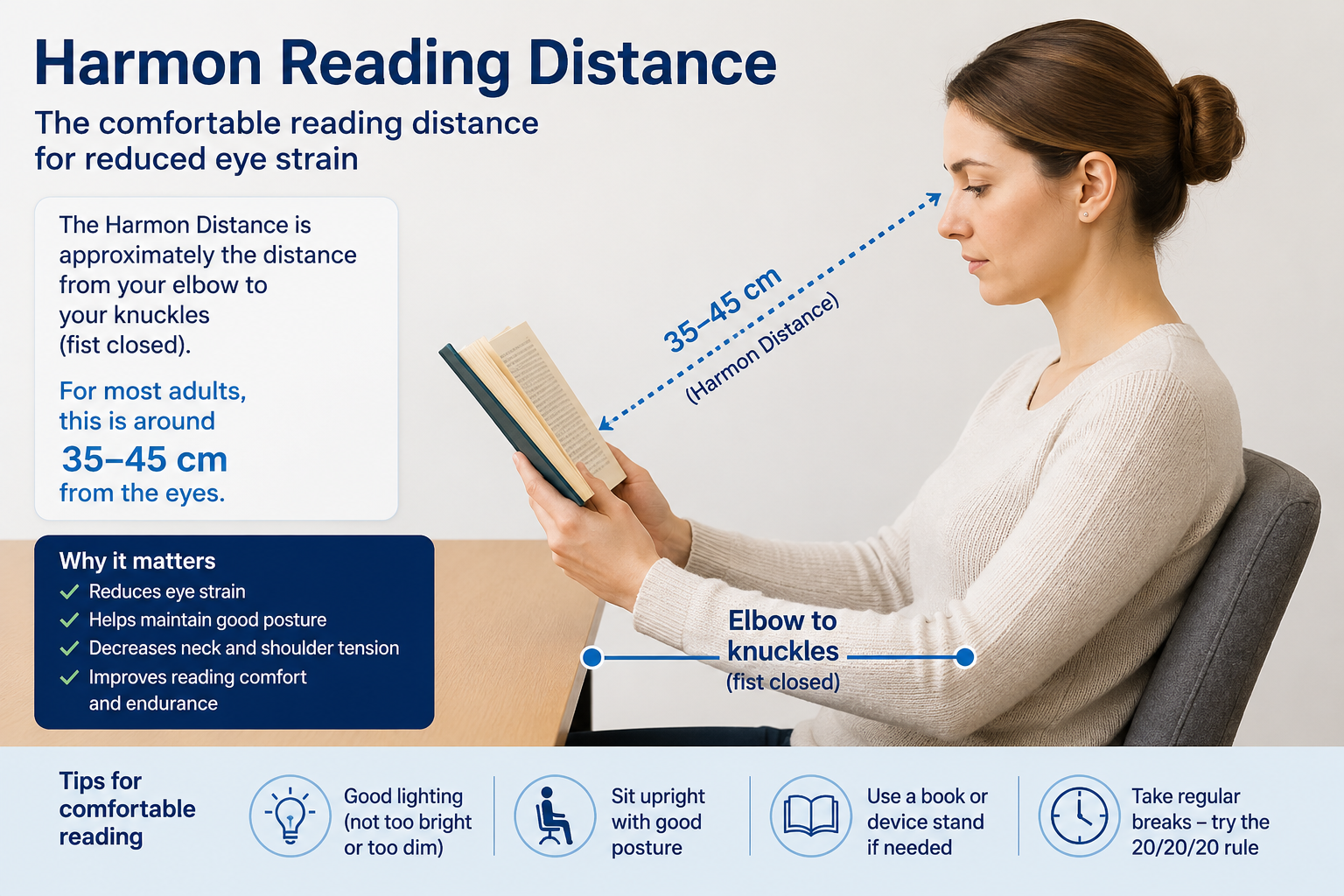
Harmon Reading distance to manage eye strain.
The Harmon distance is a natural guideline for comfortable near work:
Approximately the distance from your elbow to your knuckles (fist closed)
For most adults:
35–45 cm from the eyes
Why it matters
Incorrect reading distance increases strain:
Too close → excessive focusing demand
Too far → reduced clarity and extra effort
Benefits of correct distance:
Reduced eye strain
Better posture
Less neck and shoulder tension
Improved reading endurance
When Headaches Are NOT Just “Normal Eye Strain”
You should consider a full eye examination if you experience:
Headaches every time you read or use screens
Symptoms worsening over time
Difficulty sustaining focus
Children avoiding reading or homework
Relief when closing one eye
Frequent prescription changes
How an Eye Examination Helps
Standard vision tests check clarity, but reading-related headaches often require deeper assessment:
Eye coordination testing
Focusing ability evaluation
Binocular vision testing
Eye tracking and convergence assessment
Dry eye testing
At practices such as Rose Optometry in Berry, these assessments help determine whether symptoms are optical, muscular, or functional.
Treatment Options
Depending on the cause, management may include:
Updated glasses prescription
Even small changes can significantly reduce strain.
Reading or computer glasses
Designed specifically for near work comfort.
Vision therapy / behavioural optometry approaches
For some patients with coordination or focusing difficulties, targeted vision therapy or eye exercises may be recommended. These exercises are designed to improve how the eyes work together and support more efficient focusing during near tasks.
Dry eye management
Improving tear film stability can enhance visual clarity during reading. When the tear film is unstable, as seen in dry eye, vision may fluctuate from blink to blink. Restoring tear film stability helps provide more consistent and comfortable vision.
Visual habit changes
Including breaks, lighting improvements, and ergonomics.
Children and Reading Headaches
In children, symptoms are often misunderstood.
Watch for:
Avoiding reading or homework
Complaints of headaches after schoolwork
Losing place while reading
Using fingers to track text
Short attention span during reading
These may indicate underlying vision issues affecting learning.
Key Takeaway
Headaches after reading are a signal, not something to ignore.
They are commonly linked to:
Eye strain
Focusing fatigue
Binocular vision issues
Dry eye or visual stress
Simple habits like the 20/20/20 rule and correct reading distance can help, but persistent symptoms should be properly assessed.
A comprehensive eye examination can identify the cause and significantly improve comfort and reading performance.
FAQ
Why do I get headaches after reading?
Most commonly due to eye strain, focusing fatigue, or binocular vision issues where the eyes struggle to coordinate during near work.
Can glasses fix reading headaches?
Yes — if caused by prescription or focusing issues. Some patients also need dedicated reading or computer lenses.
Does screen time make it worse?
Yes. Screens reduce blinking and increase focusing demand, which can worsen symptoms.
When should I get my eyes checked?
If headaches are frequent, predictable during reading, or affecting work, study, or school performance.
