
Colour is an important part of how we see and understand the world around us. We use colour to identify objects, interpret signs and signals, read charts and maps, choose clothing and navigate everyday life.
But not everyone sees colour in exactly the same way.
Colour vision deficiency (CVD), commonly known as colour blindness, is a reduced ability to distinguish between certain colours or shades. It is relatively common and can range from a very mild difficulty distinguishing particular colours through to a more significant colour vision deficiency.
At Rose Optometry in Berry, NSW, we can assess colour vision as part of a comprehensive eye examination or provide specific colour vision testing when required.
How common is colour vision deficiency?
Colour vision deficiency is much more common in males than females.
Approximately 1 in 12 men, or around 8%, have colour vision deficiency. It is much less common in females, affecting less than 1%.
The difference is largely related to the inheritance of the most common red-green colour vision deficiencies, which are associated with genes on the X chromosome.
Colour vision problems can also develop later in life. This is known as acquired colour vision deficiency and can occur as a result of certain eye conditions, neurological conditions, some medications, injuries or ageing.
What causes colour vision deficiency?
Normal colour vision relies on specialised light-sensitive cells in the retina called cones.
Most people have three types of cone that respond to different ranges of light. The brain combines information from these cones to allow us to perceive a wide range of colours.
If one or more cone types are absent or function differently, a person may have difficulty distinguishing certain colours.
What are the types of colour vision deficiency?
The most common types of colour vision deficiency involve red and green.
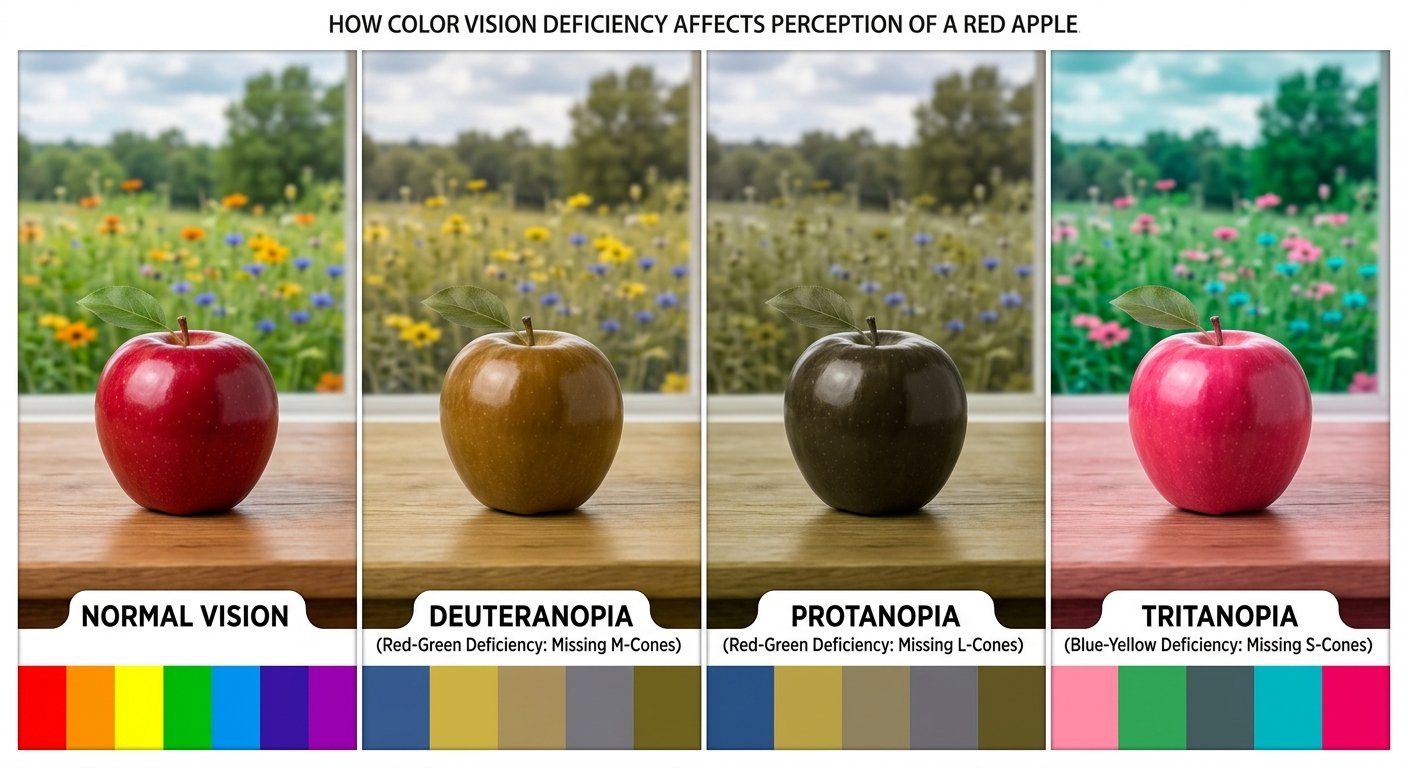
Side-by-side comparison showing how a red apple on a wooden table appears under Normal Vision, Deuteranopia (appearing brownish-yellow), Protanopia (appearing dark olive), and Tritanopia (appearing vibrant pink).
Red-green colour vision deficiency
Deuteranomaly is the most common type. It can make some shades of green, red, brown and orange more difficult to distinguish.
Protanomaly can make some reds appear less bright and make certain red and green shades harder to differentiate.
Deuteranopia and protanopia are more significant forms of red-green colour vision deficiency and can make distinguishing between red and green particularly difficult.
Blue-yellow colour vision deficiency
Blue-yellow colour vision deficiency is much less common.
Tritanomaly and tritanopia can affect the ability to distinguish certain shades of blue, green, yellow and red.
Complete colour vision deficiency
Very rarely, a person has little or no functional colour vision. This is known as complete colour vision deficiency or achromatopsia.
Colour vision deficiency can vary in severity
Colour vision deficiency is not simply a case of either seeing colour normally or seeing the world in black and white.
The severity can vary considerably.
Some people have a very mild deficiency and may not realise they have it. They may only have difficulty distinguishing particular shades or colours in certain situations.
Others may have a more significant difficulty distinguishing colours.
Lighting can also make a difference. Colours that are easy to distinguish in bright daylight may be much harder to differentiate in poor or unusual lighting.
This is why the type of colour vision test used can depend on the reason for the assessment.
How is colour vision tested?
There are several ways to assess colour vision, depending on what the test is being used for.
The Ishihara colour vision test is one of the most commonly used screening tests. It uses coloured plates containing numbers or shapes and is particularly useful for identifying common red-green colour vision deficiencies.
Other tests, including colour arrangement tests and specialised lantern tests, can provide additional information about colour discrimination when more detailed assessment is required.
The appropriate test depends on the reason for testing. A simple screening test may be suitable in some situations, while particular occupations or licensing authorities may require a specific form of colour vision assessment.

Ishihara test is the most common colour vision screening test.
Why might someone need a colour vision test?
Most people with colour vision deficiency manage very well in everyday life. However, colour vision can be particularly important when a job involves identifying coloured lights, signals, warning indicators or colour-coded information.
Occupations that may have colour vision standards or specific colour vision requirements include:
Aviation and piloting
Air traffic control
Defence and military occupations
Maritime and seafaring
Railway occupations
Electrical and technical trades
Emergency services
Some healthcare, laboratory and scientific roles
Other safety-critical occupations where coloured lights, signals or warnings are used
The requirements can vary considerably between occupations and individual roles.
For example, maritime roles involving navigation and lookout duties can have specific colour vision requirements, while rail colour vision requirements may depend on the particular tasks performed.
For this reason, if you are starting a new career, applying for a licence or entering an occupation with a colour vision standard, it is important to find out which colour vision test and standard applies to your particular role.
Having colour vision deficiency does not automatically mean someone cannot pursue a particular career. Some occupations have additional or specialised testing available.
Colour vision and children
Colour can play an important role in learning.
Children use colour to identify objects, interpret diagrams, organise information and complete classroom activities.
A child with colour vision deficiency may sometimes struggle with activities involving colour without realising that they are seeing colours differently from their classmates.
If your child regularly confuses particular colours, a colour vision assessment can help determine whether colour vision deficiency may be contributing.
Simple adjustments can also make information easier to interpret. For example, using labels, symbols, patterns or text alongside colour means that important information does not rely on colour alone.
Can colour vision deficiency be treated?
Inherited colour vision deficiency generally cannot be cured because it is related to the way the visual system detects and processes colour.
However, most people with colour vision deficiency develop strategies that allow them to manage very effectively in everyday life.
Technology can also help, with apps and digital tools available to identify colours or provide alternative ways of displaying colour-coded information.
The important consideration is understanding what type of colour vision deficiency a person has and how significant it is.
When should you have your colour vision tested?
If you have always had difficulty distinguishing particular colours, a colour vision assessment can help determine whether you have a colour vision deficiency.
It can also be useful if:
You or your child regularly confuse particular colours
Colour identification is causing difficulties at school or work
You are entering an occupation with colour vision requirements
You require colour vision testing for a licence or medical assessment
You have noticed a change in your ability to distinguish colours
A new or sudden change in colour vision should be assessed by an eye care professional, as acquired colour vision changes can sometimes be associated with an underlying eye condition or other health issue.
Colour vision testing at Rose Optometry
At Rose Optometry in Berry, NSW, we can assess colour vision as part of a comprehensive eye examination and provide specific colour vision testing when clinically or occupationally appropriate.
If you are concerned about your colour vision, have difficulty distinguishing particular colours, or require colour vision testing for work, study or another purpose, our optometrists can discuss the most appropriate assessment for you.
Rose Optometry provides eye care to patients from Berry, Nowra, the Shoalhaven, Kiama, Gerringong and surrounding areas.
Rose Optometry
14 Alexandra Street, Berry NSW
Your Vision. Our Focus.
Colour vision requirements and appropriate testing methods vary depending on the purpose of the assessment and the relevant occupational or regulatory requirements.
