
Understanding Myopia (Short-sightedness) and How to Protect Your Child’s Vision
Understanding Myopia and How to Manage It
At Rose Optometry, we understand that your child’s vision is precious. Myopia, also known as short-sightedness, is becoming increasingly common in children and young adults, and without appropriate management, it can progress and increase the risk of serious eye conditions later in life. Thankfully, modern optometry has evolved with highly effective methods to control myopia progression.
In this article, we explain what myopia is, why it matters, and the options available to help protect your or your child’s eyesight for the future.
What is Myopia?
Myopia is a type of refractive error where near objects are seen clearly, but distant objects appear blurry. It typically occurs when the eyeball is too long or the cornea (the clear front surface of the eye) is too curved. As a result, light entering the eye focuses in front of the retina instead of directly on it, causing blurred distance vision.
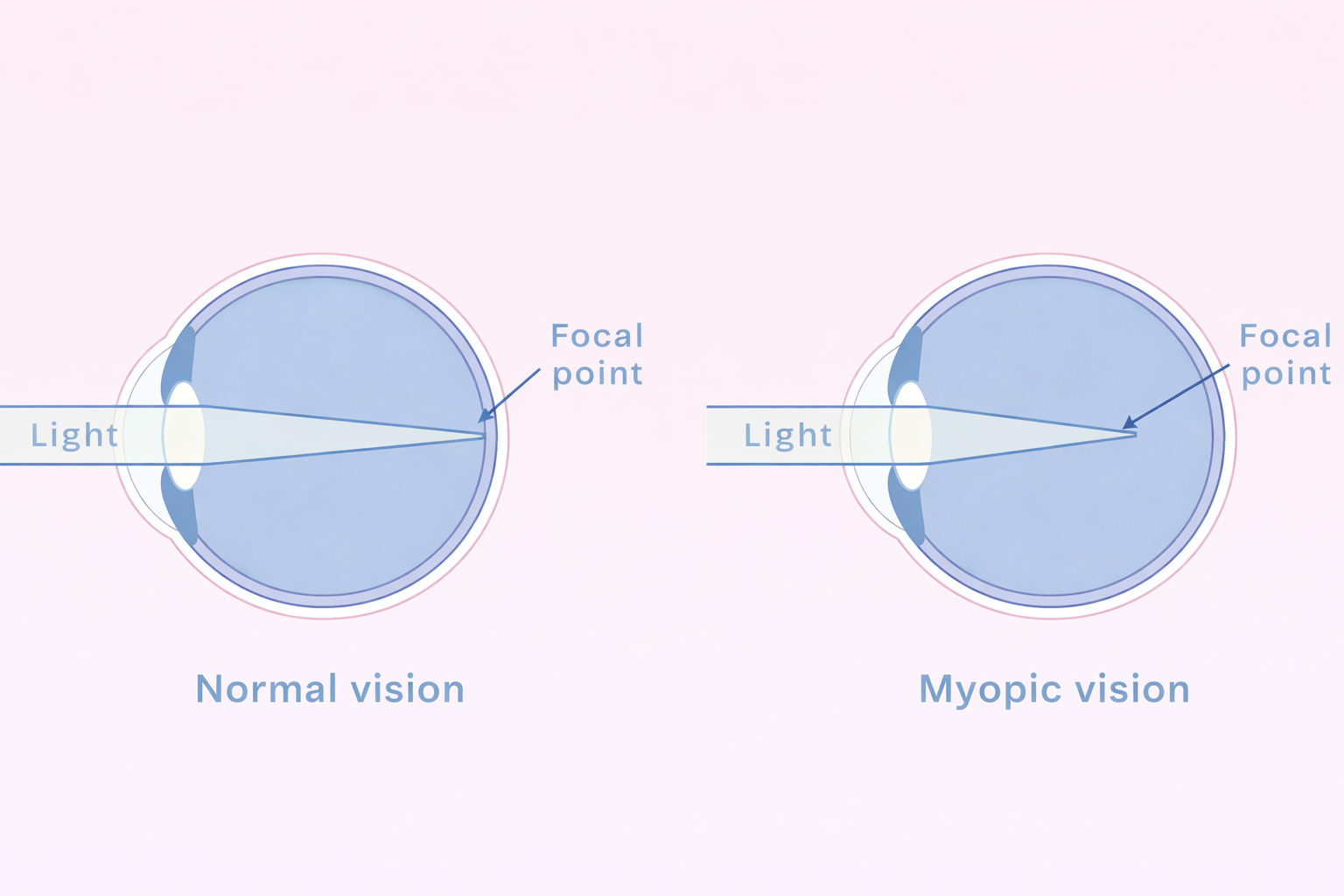
Normal focal point of eye vs myopia focal point.
Minus-powered spectacle lenses or contact lenses correct this by shifting the focal point back onto the retina.
When Does Myopia Develop?
Myopia may be congenital (present from birth), but more often it develops in school-aged children and tends to worsen through adolescence. Most people find that progression slows or stops by their mid-20s. However, this isn’t always the case.
Regular eye checks are vital to monitor for changes.
What Causes Myopia?
While the exact cause is unknown, myopia is influenced by both genetics and environment.
If one parent is myopic, their child is 3x more likely to develop myopia.
If both parents are myopic, the risk increases to 6x.
Environmental factors also play a major role:
Children who spend less time outdoors and more time on near tasks (e.g. reading, using computers, tablets, or phones) are at greater risk.
Urban living is associated with higher rates of myopia than rural environments.
A recent Australian study found:
Children spending less than 2 hours/day on near tasks had a minimal risk of developing myopia.
Children doing more than 3 hours/day of close work had a 3x greater risk.
Tips to Reduce Risk of Myopia Progression
Adopting good visual habits can help:
Limit screen and close work to under 2 hours/day where possible
Keep reading distance at least 40cm
Follow the 20/20/20 rule: every 20 minutes, take a 20-second break to look at something 6 metres away
Why Does Myopia Progression Matter?
The higher the degree of myopia, the greater the risk of long-term eye health complications, such as:
Myopic maculopathy
Retinal detachment (can lead to permanent vision loss)
Glaucoma
Earlier onset of cataracts
Higher prescriptions can also mean thicker lenses, which may impact vision clarity and comfort.
How Do I Know if Myopia is Progressing?
Increasing blur when looking at distance
Needing stronger glasses or contact lenses regularly
Some optometrists use A-scan biometry to measure eye length as an indicator of myopia progression
Myopia Control Options at Rose Optometry
At Rose Optometry, we offer a range of evidence-based treatments to help slow or even stop the progression of myopia, especially in children and teens. Here’s an overview of the available options:
1. Update Your Prescription Regularly
Doing nothing is a choice — but it’s not risk-free. Without intervention, most patients will find that their myopia continues to progress, often requiring new glasses every 12–24 months.
Wearing an outdated or under-corrected prescription may actually increase the risk of progression.
2. Multifocal Glasses or Contact Lenses
Multifocal lenses work by reducing strain during close-up tasks. They may slow myopia by 5–15%, though effectiveness can vary.
They can be a suitable option for patients not yet ready for more targeted myopia control methods.
3. Myopia Control Lenses (including MiYOSMART by Hoya)
We offer a range of clinically proven options to help slow the progression of myopia in children, including MiYOSMART lenses.
Slows myopia progression by up to 60% (MiYOSMART clinical results).
Non-invasive and easy to adapt – worn just like regular glasses.
Looks and feels like normal spectacles.
Customised solutions to suit each child’s needs.
Ideal for families seeking a simple, effective, evidence-based approach to managing myopia.
4. Atropine Eye Drops
Low-dose Atropine (usually 0.01%) is instilled once daily into each eye and is used to reduce myopia progression without affecting clarity of vision.
It’s a great option for young children or those not suitable for contact lenses, and is often used in combination with other treatments.
5. Orthokeratology (Ortho-K)
Ortho-K involves custom-designed rigid contact lenses worn overnight that gently reshape the cornea while you sleep.
Wake up with clear vision all day, no glasses or contacts needed
Slows myopia progression by up to 60–100% in many cases
Ideal for sporty or active kids who find glasses or contacts uncomfortable or impractical
Think of it like a retainer for your eyes — consistency is key
6. Laser Eye Surgery (For Adults Only)
Laser surgery can correct vision, but it does not prevent or reverse the underlying risks of high myopia (such as retinal detachment). This is generally only suitable for adults after myopia has stabilised.
When Should I Start Myopia Control?
The earlier, the better. Once myopia starts, progression can be rapid. Early detection and prompt treatment offer the best chance of reducing long-term impact.
Ready to Take the Next Step?
If your child has recently been diagnosed with myopia — or you're concerned about progression — we invite you to book a comprehensive eye examination at Rose Optometry.
We offer:
Second opinions for parents looking to confirm a treatment plan
Continuity of care for families new to the Shoalhaven, Nowra, Berry, or Kiama areas
Personalised myopia control plans using the latest tools and techniques
Book an appointment today and let our experienced optometrists help you safeguard your family's vision.
Robert Rose
Optometrist
Rose Optometry, Berry NSW
